
A year ago, in our first-year reflection, we shared the question that begins every project at Kintiq: what will this mean for the people who use it? That question still guides us. We believe technology should be designed with purpose and shaped around human experience, and that innovation is measured not by what we build but by the difference it makes in people's lives.
In that same piece, we introduced Fanvaiy as one of our flagship products. A year on, it has grown into something we are especially proud of, and it deserves a closer look. More than any other product we have built, Fanvaiy reflects what we stand for: technology built around people, their voices and the stories they want to tell.
What Fanvaiy is
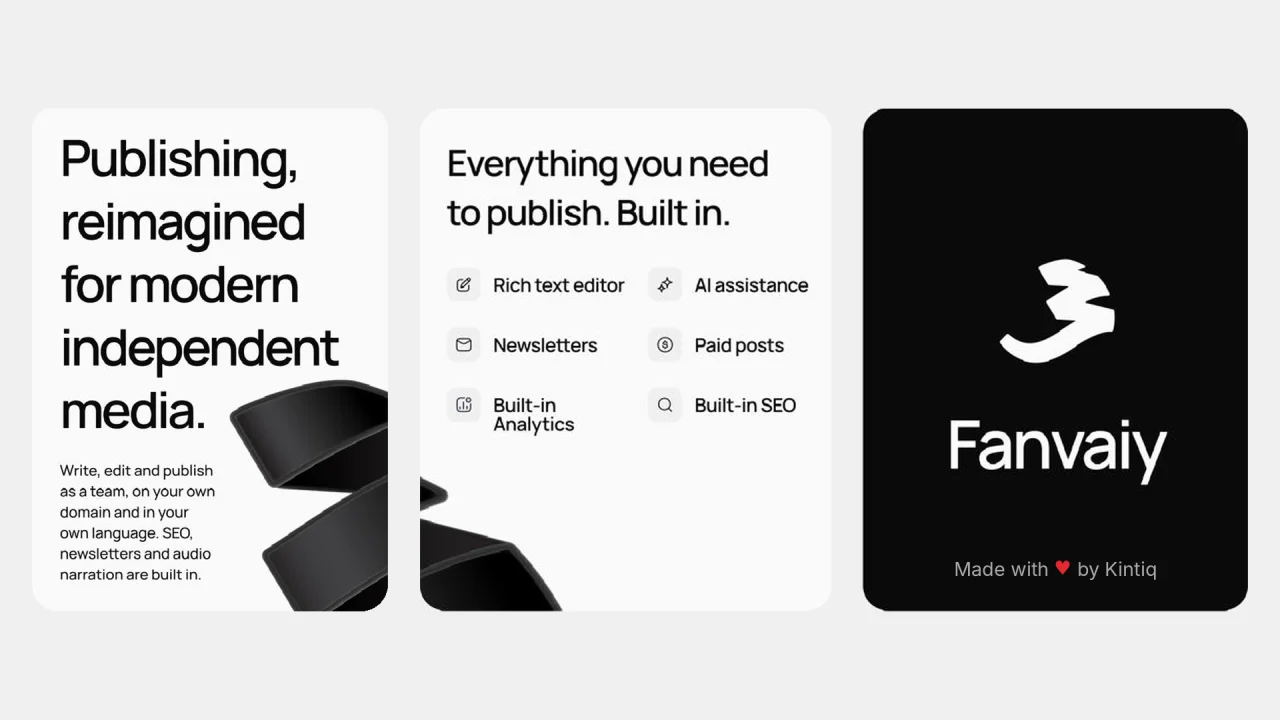
Fanvaiy is a publishing platform for online magazines, digital newspapers and independent newsrooms. It brings together everything a modern publication needs, including a thoughtful editor, editorial workflows, search visibility, newsletters, analytics and ways to earn, in one place. There is no code to write and no servers to manage, and you can start for free.
It means a small team can work like a large newsroom, and spend their time where it counts: on the stories.
Play
Why we built it
Publishing has never been easier to begin, and it has rarely been harder to sustain. Many independent publishers start on simple tools that are quick to set up but are not designed for how a newsroom really works, with editors, deadlines, reviews and many contributors. Others look at full-scale newsroom systems and find they are built for organisations with large budgets and dedicated technical teams. Much of the space in between has been left unserved.
That space matters deeply to us in the Maldives. Our news and stories travel across hundreds of islands and a scattered population, and much of that work is done by small, committed teams: local outlets, independent journalists, community voices and new publications finding their audience. Many of them write in Dhivehi, a language with its own Thaana script, which global tools have not always handled with the care it deserves.
And the Maldives is only one part of a much bigger picture. Across our region and beyond, millions of people read, write and think in languages that digital publishing has too often treated as an afterthought, especially those with their own scripts or that read from right to left. When a platform cannot fully support a language, the stories told in it are harder to publish, harder to find and easier to lose. Our vision for Fanvaiy is a platform where every language is treated as a first-class citizen, so writers can tell their stories in the language they think in. We have started with English, Dhivehi and Hindi, and we are working to introduce more languages, so that anyone, in any language, can publish their stories and access the stories that matter to them. We see each new language we add as another community whose voice can be heard more clearly.
We believe that wherever a story comes from, it deserves to be told well, in its own language, and to reach the people it is meant for. Fanvaiy began with that belief.
What Fanvaiy brings together
For writers, Fanvaiy offers a calm, focused editor with everything a story needs: rich formatting, image galleries with captions and credits, and embedded video and social posts. Work saves as you type. A built-in AI assistant can help draft a section, expand an idea or tighten a paragraph, and any article can be turned into AI-narrated audio, so readers can listen as well as read. Writers can work in English, Dhivehi with full Thaana support, or Hindi, with more languages to come.
For editors and teams, there is a proper editorial workflow. You can invite writers and contributors, assign roles and stories, send drafts for review, and schedule or publish. Every publication runs on its own domain and masthead, with a growing collection of free themes. Publishers moving from another platform can import their existing content, so their archive comes with them.
A newsroom workflow, built in: write, suggest, approve, publish.
For growing an audience, search optimisation is built in, along with newsletters, social media posting and real-time analytics that respect readers' privacy.
The Fanvaiy App, taking every story further. Available on iOS and Android, the Fanvaiy App brings writers, publishers and readers together in one place, wherever they are.
For writers: write, edit and publish straight from your phone, so a story can be captured the moment it happens, whether you are in the newsroom, on the road or on another island.
For readers: discover curated stories, browse by topic, follow favourite publications, build a personal feed and listen to stories read aloud,publications and build a personal feed, with alerts when new stories go live.
Read anywhere: save articles to read offline, whether on a ferry between islands or anywhere without a signal.
Engagement built in: readers can like, comment, subscribe and take part in polls without leaving the app.
For publishers: every publication is included automatically on every plan, free plan included, with its own name, logo and bylines, so a story published on the web reaches readers' phones too, at no extra work or cost.
The Fanvaiy App, taking every story further. Available on iOS and Android,
For sustainability, Paid Posts lets publishers set a one-time price on individual articles, with payments by card. A free writers marketplace helps publishers find writers by language and topic.
For builders, a developer API, per-site webhooks and theme tools let teams connect Fanvaiy to the tools and workflows they already use.
Who uses Fanvaiy
Maldivian newsrooms already publish on Fanvaiy. Business dailies, tourism news and Dhivehi papers run on Fanvaiy today, each on its own domain, in its own language, with its own readers. Together, they show what we hoped Fanvaiy could be: one platform carrying many different voices.
Beyond established newsrooms, Fanvaiy is built for anyone with a story worth telling and an audience worth reaching. That includes independent magazines, community publications, and journalists and bloggers who want more than a simple blog. It also serves startups and organisations that need a credible publishing presence without building one from scratch, and news agencies that want to share their reporting directly through the Fanvaiy App. Behind every one of them are the writers, editors and readers who give a publication its life, and it is for them that every feature is designed.
The people behind the stories
Fanvaiy is built by our team, but it really belongs to the people who use it: the journalists, editors, writers and readers who keep independent media alive. We are grateful to everyone who has tested it, questioned it and helped it improve.
“I have spent ten years building online magazines and newsrooms, and I kept seeing the same thing: small teams with important stories, held back by tools that were never made for them or for their language. Fanvaiy is the platform I wished those teams had. Whether you write in English, Dhivehi or Hindi, from Malé or a small island, your journalism deserves a home that treats it with care.”
— Sharif Khaleel, Founder of Kintiq
For us at Kintiq, Fanvaiy is just the beginning. It is made with love in the Maldives, for independent media everywhere. If you run a publication, or dream of starting one, we would love to welcome you. Start for free at fanvaiy.com or book a demo with our team.