
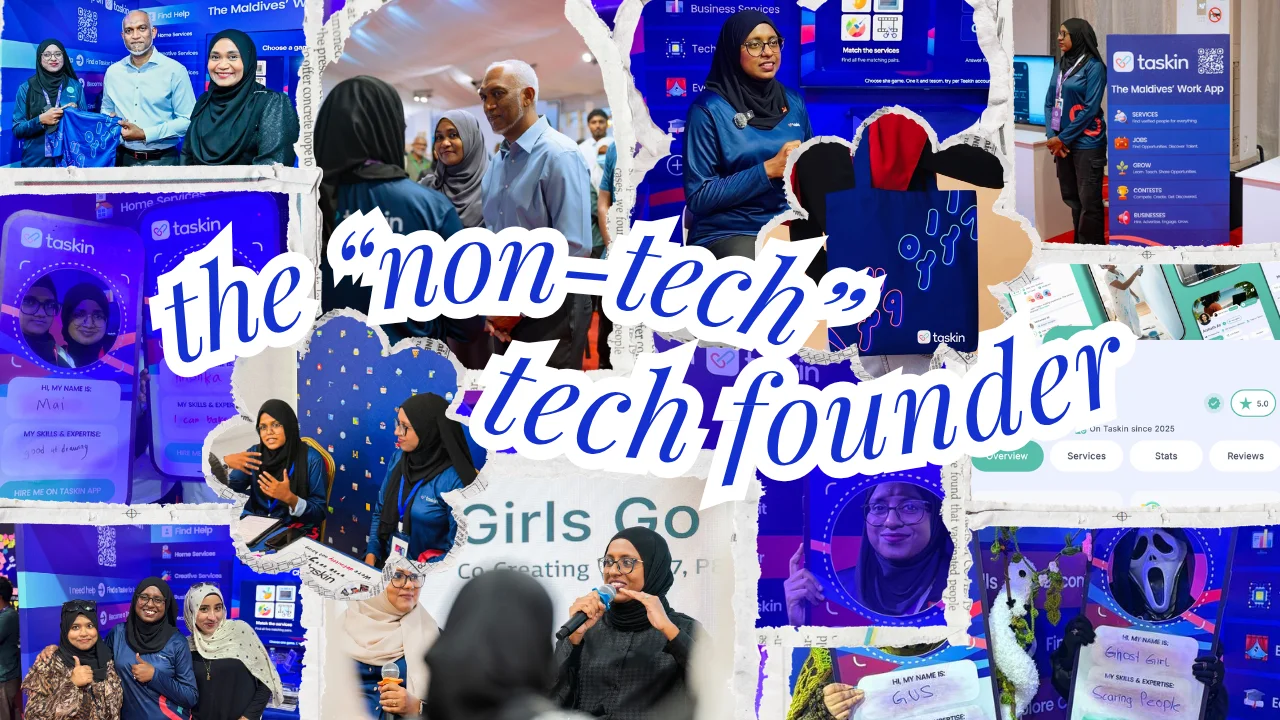
I have a confession to make.
I am the CEO and Founder of a tech platform, and I don't know how to write a single line of production code.
I had a dream to study IT after my A’levels. I did start my diploma in MNU in 2011. I was thriving. My lecturers absolutely loved my passion. After just 3 months I dropped out to find a job in a resort to financially support my mother and sister. I thought, that was it for my IT career.
For a long time, the tech startup world felt like an exclusive club with a strict entry requirement: a Computer Science degree. I did my fair share of Sales, Marketing and Human Resources in my resort career. I spent my time studying people, organizational behavior, and customer experience, not Python, React, or Javascript.
But when the vision for Taskin (previously known as Fakir App; that’s a story for another day), the Maldives’ first freelancer platform, became too loud to ignore, I realized something important: tech is just a tool. Solving human problems is the actual business.
If you are a non-technical professional sitting on a great idea, here is why your background is your biggest asset, and how you can make the leap.
1. People Skills Scale Better Than Code
What do HR, hospitality, and software have in common? They all fail if you don't understand the end-user.
In hospitality, anticipation of a guest's needs is everything. In HR, it's about understanding motivations and removing friction. When we were designing Taskin App to be 100% commission-free for service providers, those decisions weren't driven by engineering constraints. They were driven by empathy and market understanding.
Some of the world's most successful tech companies were built by founders without technical backgrounds. Brian Chesky of Airbnb trained as an industrial designer, and Whitney Wolfe Herd of Bumble studied international relations. They built massive tech companies without writing production code. Their competitive advantage was understanding the human experience.
2. The "No-Code" and AI Revolution Changed the Game
The narrative that startups require technical founders to succeed is dead.
We are living in an era where the cost and time to build a first product has dropped by over 90% in just the last two years. You don't need to spend months learning to code. Between visual builders, workflow automation tools like n8n, and AI assistants like Gemini, the technical barriers have completely vanished.
In today's landscape, the founder who deeply understands their market and can clearly articulate what needs to be built will often outperform an engineer who can code but doesn't understand the customer. AI and actual professionals handle the building; you handle the strategy, the thinking, and the relationships.
3. Focus on the "What" and "Why," Delegate the "How"
My role isn't to build the application architecture from scratch. My role is to:
Identify a specific problem worth solving
Talk to customers and validate the demand
Define the exact Minimum Viable Product (MVP)
Collaborate with brilliant developers who can translate my visual synthesis and workflows into a scalable product
A technical co-founder or engineering team who joins after you have already proven demand and defined the customer is far more valuable than one who joins based on an untested concept.
The Takeaway
If you are coming from HR, hospitality, marketing, or sales, do not count yourself out of the tech space. Your ability to read people, build communities, and design seamless experiences is exactly what the tech world desperately needs.
You don't need to speak the language of machines if you already speak the language of your customers.